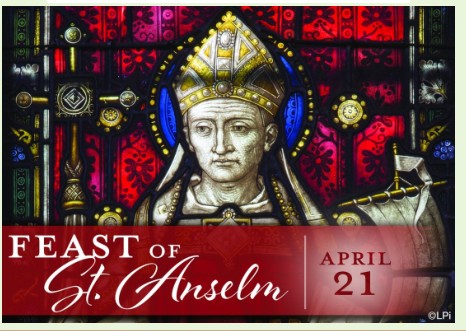
St. Anselm of Canterbury left his home in Italy to travel as a young man and ended up at the monastery in Bec, France, which was known for the teachings of its leader, Lanfranc. Anselm rose quickly to become abbot of the community and his writings are now compared in importance to those of St. Augustine.
In 1093 Anselm was appointed Archbishop of Canterbury by William II Rufus, the son and successor of William the Conqueror. However, at the time there was a controversy in Europe over whether kings or the pope had the power to invest bishops. Anselm, who believed only the pope should have the right to invest an ecclesiastical authority, spent much of his time as Archbishop exiled in Rome.
St. Anselm’s teaching and works of theology are his most important contribution to the Catholic faith. He is considered of the fathers of scholastic theology and his chief achievement in philosophy was the ontological argument for the existence of God. His work Cur Deus homo? taught that atonement for sins could only be achieved through Christ. He was canonized in 1494 and named a Doctor of the Church in 1720.
St. Faustina (1905-1938) was born Helena Kowalska in Poland to a poor family with ten children. They were devoutly Catholic, and she felt a call to the religious life at age seven, when praying in front of the exposed Eucharist. Despite wanting to become a sister as soon as she finished her schooling, she was sent to work as a housekeeper to help support the family instead.
When she was 18, she had a vision of Jesus suffering and, in the vision, Jesus asked her how long she would keep putting off entering religious life. She decided, at that moment, to travel to Warsaw and join the Congregation of the Sisters of Our Lady of Mercy. Upon entering the Congregation, she took the name Sister Maria Faustina.
During her 13 years in the Congregation, Sister Faustina experienced and recorded extraordinary revelations from Jesus. She recorded these experiences and messages into notebooks which became later known as the Diary of Saint Maria Faustina Kowalska. In these writings, she reveals Jesus asking her to proclaim God’s loving message of Divine Mercy.
Alongside her writings, Sister Faustina also experienced many miraculous phenomena. There are stories of her experiencing hidden stigmata, bilocation, prophecy, and the ability to read into human souls. Despite these occurrences, she maintained that miraculous events were simply “ornaments” for the soul and that her real sanctity came from her deep relationship with Jesus and desire to do God’s will.
After her death at age 33, her writings on Divine Mercy sparked a great movement in the worldwide Catholic church with a strong focus on the Mercy of Christ and how to extend that mercy to others. Saint Pope John Paul II called her “the great apostle of Divine Mercy in our time.” St. Faustina, pray for us!
Saint Joseph Husband of the Blessed Virgin Mary First Century
Feast Day: March 19
Patron Saint of the Universal Church, fathers, carpenters, and a happy death
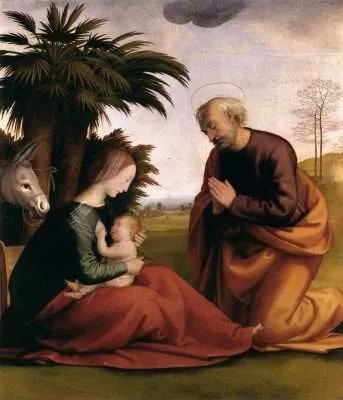
The Father in Heaven chose Mary who was the Immaculate Conception to bear His Son in her womb, bring Him into the world, and raise Him from infancy to adulthood. Of all the men in Israel that the Father could have chosen to be Jesus’ foster father, He chose Joseph of Nazareth, a carpenter. Today’s solemnity honors Joseph and points us to his marital union with the Blessed Virgin Mary and to the effect that their marriage had not only on the Holy Family, but also upon us as members of the Body of Christ.
Joseph was born in the small town of Bethlehem but moved to Nazareth with Mary and Jesus after returning from Egypt in order to keep Jesus safe from Archelaus, the ruler of Judea. Nothing is known about Joseph for certain except what is contained in the Gospels. But the Gospels tell us all we need to know about this holy, obedient, and just man, who was given authority over the Son of God and continues to exercise a holy authority over the entire Church.
Saint Joseph was obedient to the Father in Heaven, and that obedience deepened his union with Mary his spouse, making their marriage the ideal family for the Son of God. Saint Joseph’s obedience is clearly seen in his response to four dreams by which an angel instructs Joseph how best to guard and protect the Son of God. Joseph acts immediately, in obedience, to the angel’s instructions. His obedience to the Father enables him to become a powerful instrument of the Father’s authority on earth, exercised through him.
Saint Joseph exercised the authority of the Father by protecting the Son of God and expecting obedience from the Son as His earthly father. That Jesus was obedient to Joseph is made clear in the Gospels: “He went down with them and came to Nazareth and was obedient to them…” (Luke 2:52).
Saint of the Week February 08, 2026
Feast Day February 14
Saint of the Week January 25, 2026
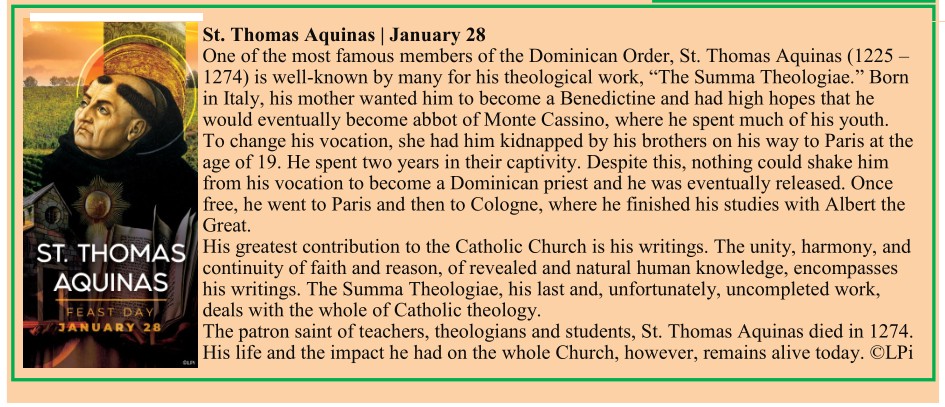
St. Thomas Aquinas Feast Day, January 28
Saint of the Week January 11, 2026
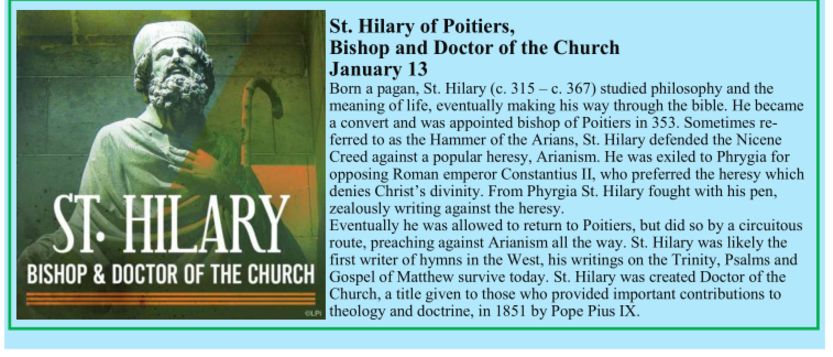
Feast Day January 13
Saint of the Week January 04, 2026
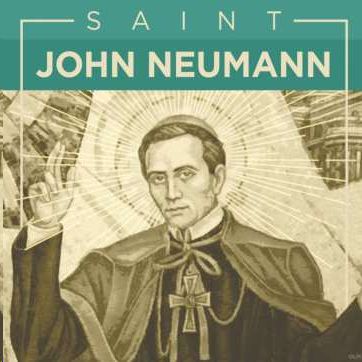
St. John Neumann Feast Day January 5
St. John Neumann is the patron saint of educators, immigrants, and, due to the miracles that secured his canonization, sick children. This is a fitting patronage as he was a lover of education and learning from a very young age. In fact, when he was a child, his mother called him “my little bibliomaniac” due to his preoccupation with reading. Born in 1811 Bohemia, in what is now the Czech Republic, he attended the university in Prague preparing for ordination. However, his local bishops were not ordaining new priests at the time because Bohemia was overstocked with priests. He inquired about ordination all over Europe but received the same answer everywhere. Not one to be deterred, John then applied to several United States dioceses. Receiving no immediate responses, the saint took a leap of faith and decided to just immigrate to the United States in 1836, during his 25th year, with only $40 in his pocket. This risk paid off when he was ordained in New York a month later.
Early in his priesthood he worked primarily as a missionary to German immigrants in Buffalo. His missionary work also created an opportunity for him to spend time in Maryland, Virginia, Michigan, and Ohio. When he was 29, he joined the Congregation of the Most Holy Redeemer (Redemptorists), a congregation of priests and brothers dedicated to helping the poor and most abandoned. He was their first member to profess vows in the United States.
In 1852, at the age of 41, Neumann became the fourth Bishop of Philadelphia. During this time, he organized the individual parochial schools in his region into a diocesan system. This change allowed Catholic schools to quickly increase the number of pupils enrolled by almost twentyfold. Over the course of his ministry, St. John expanded the number of Catholic schools in his diocese from 2 to 100! His passion for education extended to immigrants, like himself, and his love for learning languages made it possible for him to hear confessions in English, Spanish, French, Italian, Dutch, and Gaelic!
A man of the people, he could often be found outside the church walls visiting people who were sick, staying in taverns and public houses to teach, and celebrating Mass in people’s homes at their kitchen tables. He was canonized on June 19, 1977, following three miracles, two of which regarded the healing of youth from grave illnesses. St. John Neumann was the first American man to be canonized a saint.
Prayer for St. John Neumann’s intercession O St. John Neumann, your ardent desire of bringing all souls to Christ impelled you to leave home and country; teach us to live worthily in the spirit of our baptism which makes us all children of the one Heavenly Father and brothers of Jesus Christ, the firstborn of the family of God.
Obtain for us that complete dedication in the service of the needy, the weak, the afflicted, and the abandoned which so characterized your life. Help us to walk perseveringly in the difficult and at times painful paths of duty, strengthened by the Body and Blood of our Redeemer and under the watchful protection of Mary our Mother. May death still find us on the sure road to our Father’s house, with the light of living faith in our hearts. (Prayer Source: https://stjohnneumann.org/
Saint of the Week December 28, 2025
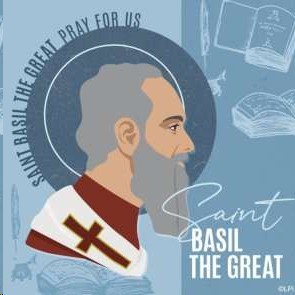
St. Basil the Great (329 – Jan. 1, 379) Feast Day January 2
St. Basil the Great (329 – January 1, 379) shares his feast day with his lifelong friend St. Gregory of Nazianzen. These
accomplished men fought against heresies that threatened the foundations of the early Church, shaping doctrines around Christ’s divinity and the nature of the Holy Trinity.
St. Basil was born at Caesarea of Cappadocia, to a family already deeply rooted in Christianity, going back to the time of widespread persecution in the 1st and 2nd centuries. Following in the footsteps of his father, Basil studied in Caesarea as well as Constantinople and Athens, training in the law and rhetoric. He became a popular teacher. However, his sister persuaded him to give up academia for monastic life. Before inviting St. Gregory to start an order with him, St. Basil traveled through Egypt, Palestine and Syria visiting monasteries, learning everything he could and formulating his own ideas about monastic rule. His rule is still followed today, and he is known as the Father of Eastern Monasticism.
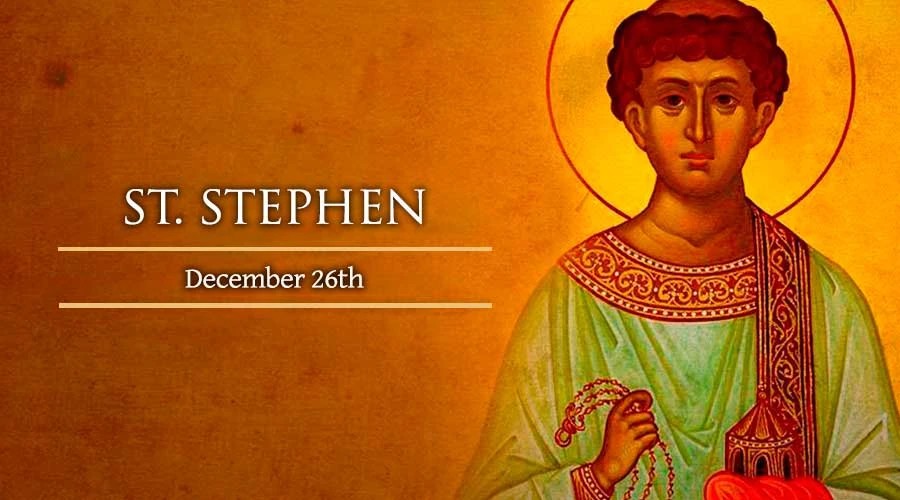
St. StephenSt. StephenFeast Day December 26 Patron Saint of Deacons and Altar Servers
The Acts of the Apostles tells the story of St. Stephen, the first Christian martyr. A man filled with grace and power, he worked great wonders among the people. Some Jews debated with St. Stephen but could not match his wisdom and spirit. Eventually, a charge of blasphemy was brought up against him, and the local population demanded that he be tried and sentenced. He was seized and carried before the Sanhedrin.
Despite the danger he faced, in front of the Sanhedrin and his accusers, St. Stephen gave a long speech about the history of Israel and the blessings that God had given upon His chosen people. He talked about how Israel had become disobedient despite God’s abundant mercy. This enraged his accusers, and eventually the crowd dragged him out of the city and stoned him to death.
Even in his final moments, St. Stephen displayed great forgiveness and even asked God not to hold the sins of his attackers against them. Hundreds of years after his death, he is still a role model for us to follow.
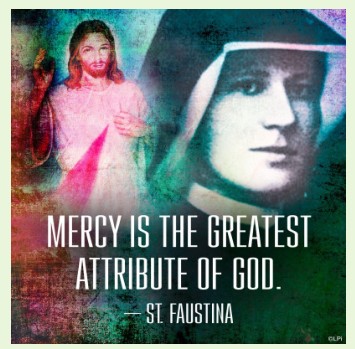 St. Faustina (1905-1938) was born Helena Kowalska in Poland to a poor family with ten children. They were devoutly Catholic, and she felt a call to the religious life at age seven, when praying in front of the exposed Eucharist. Despite wanting to become a sister as soon as she finished her schooling, she was sent to work as a housekeeper to help support the family instead.
 Patron Saint of the Universal Church, fathers, carpenters, and a happy death